# 💠 Qwind
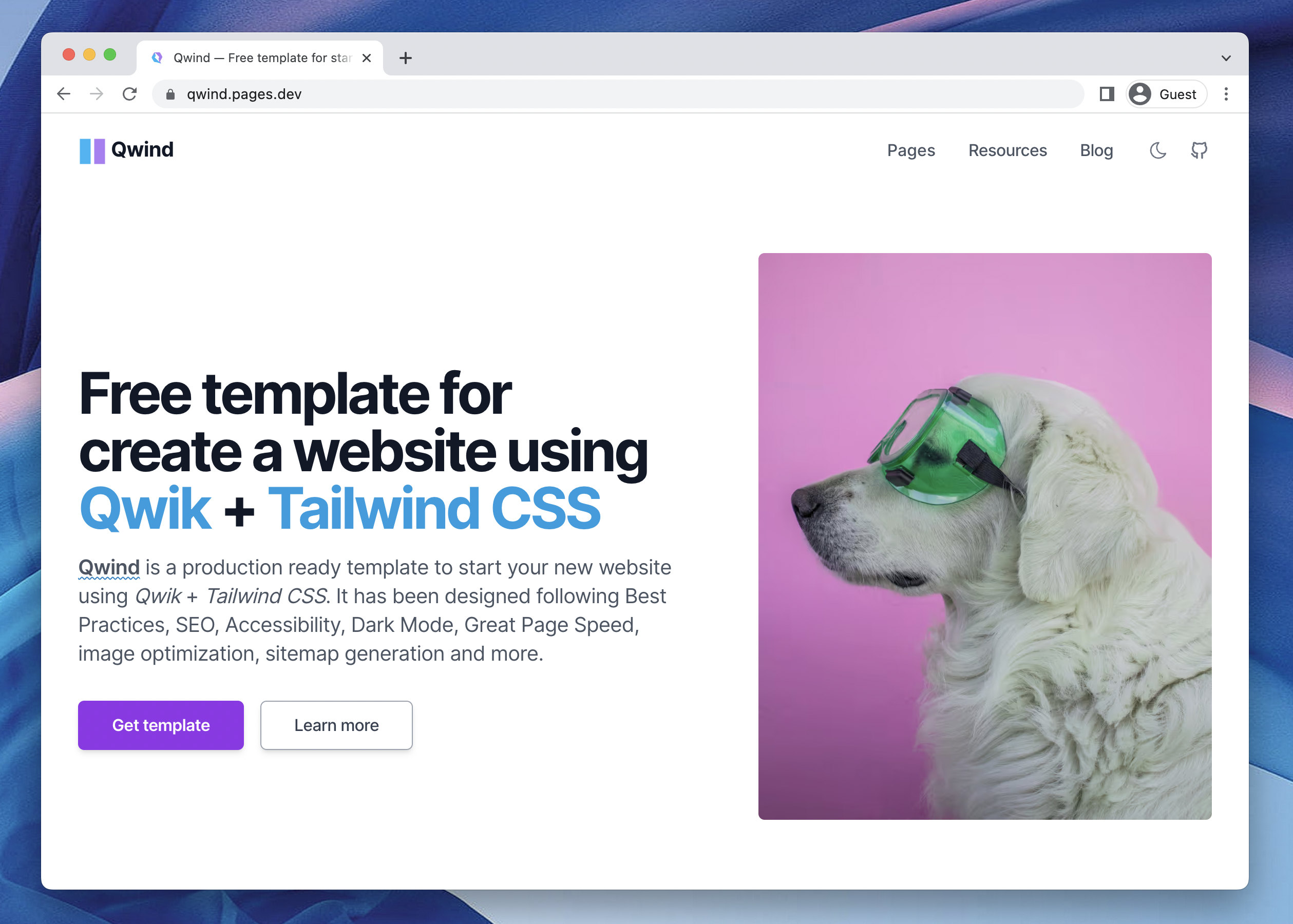
**Qwind** is a free and open-source template to make your website using **[Qwik](https://qwik.builder.io/) + [Tailwind CSS](https://tailwindcss.com/)**. Ready to start a new project and designed taking into account best practices.
## Features
- ✅ Integration with **Tailwind CSS** supporting **Dark mode**.
- ✅ **Production-ready** scores in [Lighthouse](https://web.dev/measure/) and [PageSpeed Insights](https://pagespeed.web.dev/) reports.
- ✅ **Image optimization** and **Font optimization**.
 [](https://onwidget.com)
[](https://github.com/onwidget/qwind/blob/main/LICENSE.md)
[](https://github.com/onwidget)
[](https://github.com/onwidget/qwind#contributing)
[](https://snyk.io/test/github/onwidget/qwind)
[](https://onwidget.com)
[](https://github.com/onwidget/qwind/blob/main/LICENSE.md)
[](https://github.com/onwidget)
[](https://github.com/onwidget/qwind#contributing)
[](https://snyk.io/test/github/onwidget/qwind)
Table of Contents
- [Demo](#demo)
- [Getting started](#getting-started)
- [Project structure](#project-structure)
- [Commands](#commands)
- [Configuration](#configuration)
- [Deploy](#deploy)
- [Roadmap](#roadmap)
- [Contributing](#contributing)
- [Acknowledgements](#acknowledgements)
- [License](#license)
## Demo
📌 [https://qwind.pages.dev/](https://qwind.pages.dev/)
## Getting started
This project is using Qwik with [QwikCity](https://qwik.builder.io/qwikcity/overview/). QwikCity is just a extra set of tools on top of Qwik to make it easier to build a full site, including directory-based routing, layouts, and more.
### Project structure
Inside **Qwind** template, you'll see the following folders and files:
```
/
├── adaptors/
| └── static/
| └── vite.config.ts
├── public/
│ ├── favicon.svg
│ ├── manifest.json
│ └── robots.txt
├── src/
│ ├── assets/
│ │ ├── images/
| | └── styles/
| | └── global.css
│ ├── components/
│ │ ├── atoms/
│ │ ├── core/
│ │ ├── icons/
| | └── widgets/
| | ├── Header.astro
| | ├── Footer.astro
| | └── ...
│ ├── routes/
│ | ├── blog/
│ | ├── index.astro
| | ├── layout.tsx
| | └-- service-worker.ts
│ ├── config.mjs
│ ├── entry.dev.tsx
│ ├── entry.preview.tsx
│ ├── entry.ssr.tsx
│ └── root.tsx
├── package.json
└── ...
```
- `src/routes`: Provides the directory based routing, which can include a hierarchy of `layout.tsx` layout files, and an `index.tsx` file as the page. Additionally, `index.ts` files are endpoints. Please see the [routing docs](https://qwik.builder.io/qwikcity/routing/overview/) for more info.
- `src/components`: Recommended directory for components.
- `public`: Any static assets, like images, can be placed in the public directory. Please see the [Vite public directory](https://vitejs.dev/guide/assets.html#the-public-directory) for more info.
[](https://githubbox.com/onwidget/qwind/tree/main)
> **Seasoned qwik expert?** Delete this file. Update `config.mjs` and contents. Have fun!
### Commands
All commands are run from the root of the project, from a terminal:
| Command | Action |
| :-------------------- | :------------------------------------------------- |
| `npm install` | Installs dependencies |
| `npm run dev` | Starts local dev server at `127.0.0.1:5173/` |
| `npm run build` | Build your production site to `./dist/` |
| `npm run preview` | Preview your build locally, before deploying |
| `npm run fmt` | Format codes with Prettier |
| `npm run lint` | Run Eslint |
| `npm run qwik ...` | Run CLI commands like `qwik add`, `qwik build` |
### Configuration
Basic configuration file: `./src/config.mjs`
```javascript
export const SITE = {
name: 'Example',
origin: 'https://example.com',
basePathname: '/', // Change this if you need to deploy to Github Pages, for example
trailingSlash: true, // Generate permalinks with or without "/" at the end
};
```
### Deploy
#### Deploy to production (manual)
You can create an optimized production build with:
```shell
npm run build
```
Now, your website is ready to be deployed. All generated files are located at
`dist` folder, which you can deploy the folder to any hosting service you
prefer.
#### Deploy to Netlify
Clone this repository on own GitHub account and deploy to Netlify:
[](https://app.netlify.com/start/deploy?repository=https://github.com/onwidget/qwind)
#### Deploy to Vercel
Clone this repository on own GitHub account and deploy to Vercel:
[](https://vercel.com/new/clone?repository-url=https%3A%2F%2Fgithub.com%2Fonwidget%2Fqwind)
## Roadmap
### Base
- [ ] Create utilities to generate permalinks tailored to the domain and base pathname.
- [ ] Simplify the way to optimize images.
- [ ] Create component to make SEO simpler and more intuitive.
- [ ] Create configurable blog with categories, tags and authors using MDX.
- [ ] Add more frequently used pages (Portfolio, Services, Contact, Docs ...).
- [ ] Find or create a library to have more icon sources available.
- [ ] Refactor some code that doesn't follow Qwik conventions yet.
### Advanced
- [ ] Achieve perfect 100% Google Page Speed score.
- [ ] Insert complex javascript example widget on home page to demonstrate Qwik features.
- [ ] Create small illustrative admin backend.
## Contributing
If you have any idea, suggestions or find any bugs, feel free to open a discussion, an issue or create a pull request.
That would be very useful for all of us and we would be happy to listen and take action.
## Acknowledgements
Initially created by [onWidget](https://onwidget.com) and maintained by a community of [contributors](https://github.com/onwidget/qwind/graphs/contributors).
## License
**Qwind** is licensed under the MIT license — see the [LICENSE](https://github.com/onwidget/qwind/blob/main/LICENSE.md) file for details.
## Cloudflare Pages
Cloudflare's [wrangler](https://github.com/cloudflare/wrangler) CLI can be used to preview a production build locally. To start a local server, run:
```
npm run serve
```
Then visit [http://localhost:8787/](http://localhost:8787/)
### Deployments
[Cloudflare Pages](https://pages.cloudflare.com/) are deployable through their [Git provider integrations](https://developers.cloudflare.com/pages/platform/git-integration/).
If you don't already have an account, then [create a Cloudflare account here](https://dash.cloudflare.com/sign-up/pages). Next go to your dashboard and follow the [Cloudflare Pages deployment guide](https://developers.cloudflare.com/pages/framework-guides/deploy-anything/).
Within the projects "Settings" for "Build and deployments", the "Build command" should be `npm run build`, and the "Build output directory" should be set to `dist`.
### Function Invocation Routes
Cloudflare Page's [function-invocation-routes config](https://developers.cloudflare.com/pages/platform/functions/function-invocation-routes/) can be used to include, or exclude, certain paths to be used by the worker functions. Having a `_routes.json` file gives developers more granular control over when your Function is invoked.
This is useful to determine if a page response should be Server-Side Rendered (SSR) or if the response should use a static-site generated (SSG) `index.html` file.
By default, the Cloudflare pages adaptor _does not_ include a `public/_routes.json` config, but rather it is auto-generated from the build by the Cloudflare adaptor. An example of an auto-generate `dist/_routes.json` would be:
```
{
"include": [
"/*"
],
"exclude": [
"/_headers",
"/_redirects",
"/build/*",
"/favicon.ico",
"/manifest.json",
"/service-worker.js",
"/about"
],
"version": 1
}
```
In the above example, it's saying _all_ pages should be SSR'd. However, the root static files such as `/favicon.ico` and any static assets in `/build/*` should be excluded from the Functions, and instead treated as a static file.
In most cases the generated `dist/_routes.json` file is ideal. However, if you need more granular control over each path, you can instead provide you're own `public/_routes.json` file. When the project provides its own `public/_routes.json` file, then the Cloudflare adaptor will not auto-generate the routes config and instead use the committed one within the `public` directory.
## Cloudflare Pages
Cloudflare's [wrangler](https://github.com/cloudflare/wrangler) CLI can be used to preview a production build locally. To start a local server, run:
```
npm run serve
```
Then visit [http://localhost:8787/](http://localhost:8787/)
### Deployments
[Cloudflare Pages](https://pages.cloudflare.com/) are deployable through their [Git provider integrations](https://developers.cloudflare.com/pages/platform/git-integration/).
If you don't already have an account, then [create a Cloudflare account here](https://dash.cloudflare.com/sign-up/pages). Next go to your dashboard and follow the [Cloudflare Pages deployment guide](https://developers.cloudflare.com/pages/framework-guides/deploy-anything/).
Within the projects "Settings" for "Build and deployments", the "Build command" should be `npm run build`, and the "Build output directory" should be set to `dist`.
### Function Invocation Routes
Cloudflare Page's [function-invocation-routes config](https://developers.cloudflare.com/pages/platform/functions/function-invocation-routes/) can be used to include, or exclude, certain paths to be used by the worker functions. Having a `_routes.json` file gives developers more granular control over when your Function is invoked.
This is useful to determine if a page response should be Server-Side Rendered (SSR) or if the response should use a static-site generated (SSG) `index.html` file.
By default, the Cloudflare pages adaptor _does not_ include a `public/_routes.json` config, but rather it is auto-generated from the build by the Cloudflare adaptor. An example of an auto-generate `dist/_routes.json` would be:
```
{
"include": [
"/*"
],
"exclude": [
"/_headers",
"/_redirects",
"/build/*",
"/favicon.ico",
"/manifest.json",
"/service-worker.js",
"/about"
],
"version": 1
}
```
In the above example, it's saying _all_ pages should be SSR'd. However, the root static files such as `/favicon.ico` and any static assets in `/build/*` should be excluded from the Functions, and instead treated as a static file.
In most cases the generated `dist/_routes.json` file is ideal. However, if you need more granular control over each path, you can instead provide you're own `public/_routes.json` file. When the project provides its own `public/_routes.json` file, then the Cloudflare adaptor will not auto-generate the routes config and instead use the committed one within the `public` directory.
## Express Server
This app has a minimal [Express server](https://expressjs.com/) implementation. After running a full build, you can preview the build using the command:
```
npm run serve
```
Then visit [http://localhost:8080/](http://localhost:8080/)
## Netlify
This starter site is configured to deploy to [Netlify Edge Functions](https://docs.netlify.com/edge-functions/overview/), which means it will be rendered at an edge location near to your users.
### Local development
The [Netlify CLI](https://docs.netlify.com/cli/get-started/) can be used to preview a production build locally. To do so: First build your site, then to start a local server, run:
1. Install Netlify CLI globally `npm i -g netlify-cli`.
2. Build your site with both ssr and static `npm run build`.
3. Start a local server with `npm run serve`.
In this project, `npm run serve` uses the `netlify dev` command to spin up a server that can handle Netlify's Edge Functions locally.
4. Visit [http://localhost:8888/](http://localhost:8888/) to check out your site.
### Edge Functions Declarations
[Netlify Edge Functions declarations](https://docs.netlify.com/edge-functions/declarations/)
can be configured to run on specific URL patterns. Each edge function declaration associates
one site path pattern with one function to execute on requests that match the path. A single request can execute a chain of edge functions from a series of declarations. A single edge function can be associated with multiple paths across various declarations.
This is useful to determine if a page response should be Server-Side Rendered (SSR) or
if the response should use a static-site generated (SSG) `index.html` file instead.
By default, the Netlify Edge adaptor will generate a `.netlify/edge-middleware/manifest.json` file, which is used by the Netlify deployment to determine which paths should, and should not, use edge functions.
To override the generated manifest, you can [add a declaration](https://docs.netlify.com/edge-functions/declarations/#add-a-declaration) to the `netlify.toml` using the `[[edge_functions]]` config. For example:
```toml
[[edge_functions]]
path = "/admin"
function = "auth"
```
### Deployments
You can [deploy your site to Netlify](https://docs.netlify.com/site-deploys/create-deploys/) either via a Git provider integration or through the Netlify CLI. This starter site includes a `netlify.toml` file to configure your build for deployment.
#### Deploying via Git
Once your site has been pushed to your Git provider, you can either link it [in the Netlify UI](https://app.netlify.com/start) or use the CLI. To link your site to a Git provider from the Netlify CLI, run the command:
```shell
netlify link
```
This sets up [continuous deployment](https://docs.netlify.com/site-deploys/create-deploys/#deploy-with-git) for your site's repo. Whenever you push new commits to your repo, Netlify starts the build process..
#### Deploying manually via the CLI
If you wish to deploy from the CLI rather than using Git, you can use the command:
```shell
netlify deploy --build
```
You must use the `--build` flag whenever you deploy. This ensures that the Edge Functions that this starter site relies on are generated and available when you deploy your site.
Add `--prod` flag to deploy to production.